


Yes, most Ontario small business grants are taxable income and must be reported on your business tax return in the year you receive them.
The CRA classifies non-repayable government assistance as business income under Canada.ca — Sources of income, whether the grant came from a federal, provincial, or municipal program. Receiving the grant from a local source does not change the tax classification.
The grant amount is taxable in the year it is received, not the year it is spent. Sole proprietors report grant income on their T1 return. Incorporated Ontario businesses report it on the T2 corporate return.
For Ontario Canadian-Controlled Private Corporations (CCPCs), the combined federal-Ontario small business tax rate on the first $500,000 of active business income is approximately 12.2%, 9% federal plus 3.2% provincial. For sole proprietors, the grant is added to personal income and taxed at the marginal rate.
Ontario small business owners who handle their own bookkeeping often encounter grant income without knowing how the CRA classifies it.
How Are Business Grants Taxed in Canada?
The Taxability Rule
The CRA treats government grants and subsidies as either business income or a reduction of the related deductible expense, depending on how the grant was used. Two treatments exist; the correct treatment depends on the grant’s purpose, not the grant amount.
Grants received with no restriction on use are reported as income using the Revenue method. Grants tied to a specific operating cost are applied using the Expense Reduction method, which reduces the related expense before it is reported on the return. The grant purpose determines which method applies. Canada.ca — Business expenses confirms that government assistance either reduces the related expense or is included in income in the year received.
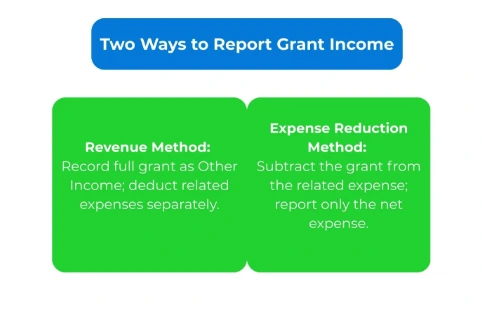
Two Ways to Report Grant Income
Ontario business owners report grant income using 1 of 2 CRA-recognized methods: the Revenue method or the Expense Reduction method.
The Revenue method records the full grant as Other Income on the tax return. Related expenses are deducted separately. This method applies when the grant has no restriction on how it is spent.
The Expense Reduction method subtracts the grant directly from the related expense. Only the net expense amount is reported. This method applies when the grant is tied to a specific deductible cost, such as marketing, rent, or professional fees.
The method chosen must match how the grant was actually used. Mismatches between the grant purpose and the reporting method create CRA compliance exposure at year-end.
| Method | How It Works | Example | Best For |
| Revenue Method | Record full grant as Other Income; deduct related expenses separately | $10,000 grant reported as income; $10,000 marketing expense deducted separately | Grants with no restriction on use |
| Expense Reduction Method | Subtract the grant from the related expense; report only the net expense | $5,000 grant for marketing → net marketing expense = $0 (if costs = $5,000) | Grants tied to a specific deductible cost |
An experienced bookkeeper in Ontario applies the correct method at year-end to avoid CRA mismatches on the T2 or T1 return. QuickBooks Canada confirms this accounting treatment for grant income.
When Do You Report the Grant? (Timing Rules)
Grant income is taxable in the year the CRA considers it received, not the year the grant funds are spent.
Cash-basis businesses report the grant in the fiscal year the funds arrive in the bank account. Accrual-basis businesses, which include most incorporated Ontario companies, report the grant in the year the right to receive it is established. That date may fall before the funds actually arrive.
Spending the grant in a later year does not defer the tax obligation. For example, an Ontario corporation approved for a $15,000 grant in December 2024 but paid in January 2025 reports the income in 2024 if the right to receive was established in that year. Timing the grant receipt and the related expense deductions to the same fiscal year is the most effective way to reduce the net tax impact.
What If You Used the Grant to Buy Equipment or Assets?
A grant used to purchase depreciable property, such as equipment, machinery, or vehicles, reduces the capital cost of that asset rather than being recorded as income. This treatment applies when the grant is directly connected to the asset purchase.
How Grants Affect Capital Cost Allowance (CCA)
A government grant applied to a depreciable asset reduces the asset’s undepreciated capital cost (UCC), the base on which all future CCA deductions are calculated.
Capital Cost Allowance is the CRA’s system for deducting the cost of long-lived business assets over time. Assets are grouped into CCA classes. Each class has a set depreciation rate. The annual CCA deduction is calculated as a percentage of the UCC remaining in that class.
When a grant reduces the capital cost, every future CCA claim is calculated on a smaller base. The tax benefit of owning the asset is permanently reduced by the grant amount. This reduction is legislated under the Income Tax Act s. 13(7.1), it is not discretionary.
The grant itself is not reported as income in this scenario. The capital cost reduction is the full tax consequence of receiving the grant.
Real Example: $10,000 Grant for Equipment Purchase
A $10,000 grant applied to a $15,000 equipment purchase reduces the capital cost to $5,000, the amount on which all future CCA deductions are based.
Here is how the two outcomes compare:
- Without the grant: Capital cost = $15,000. All CCA deductions are calculated on $15,000. The full purchase price is recoverable through depreciation over the asset’s CCA class life.
- With the grant: Capital cost = $5,000 ($15,000 − $10,000). All CCA deductions are calculated on $5,000. Only $5,000 is recoverable through future depreciation claims.
The $10,000 grant is not reported separately as income on the T2 return. The reduced capital cost is the complete tax consequence. This treatment applies regardless of which CCA class the equipment falls under: Class 8, Class 10, Class 50, or any other eligible class.
Ontario business owners who purchase equipment using grant funds must record the correct capital cost on their T2 return from year one. An incorrect opening capital cost produces compounding CCA errors across every future tax year. See CRA’s Capital Cost Allowance guidance for the full class list.
What Records Does the CRA Require for Grant Recipients?
The CRA requires Ontario grant recipients to keep all grant-related records for a minimum of 6 years from the end of the last tax year to which they relate. The 6-year clock starts from the end of the relevant tax year, not the date the grant was received.
Required records fall into 5 categories. Each category serves a specific compliance purpose.
| Document Type | Purpose | Retention Period |
| Grant award letter/agreement | Confirms grant amount, conditions, and purpose | 6 years from the end of the relevant tax year |
| Bank statement showing grant deposit | Proves the year of receipt for timing compliance | 6 years from the end of the relevant tax year |
| Receipts for grant-funded expenses | Supports expense deduction or Expense Reduction method | 6 years from the end of the relevant tax year |
| T4A slip (if issued by program) | Must match income reported on tax return | 6 years from the end of the relevant tax year |
| Asset purchase invoice (if capital purchase) | Supports capital cost reduction calculation | 6 years from the end of the relevant tax year |
The T4A slip requires special attention. Some Ontario grant programs issue a T4A to both the recipient and the CRA. The CRA’s automated matching system compares the T4A amount against the income reported on the business return. A discrepancy, even a small one, triggers a review without requiring an audit officer to get involved. See Canada.ca — Keeping records for the full record-keeping requirements.
Ontario incorporated businesses that file a corporate tax return (T2) must ensure all grant income and supporting records are reconciled before the filing deadline. Missing or incomplete records are one of the most common reasons the CRA disallows deductions and reassesses business income.
You now know the rules: Ontario small business grants are taxable income, reported in the year received, and documented for a minimum of 6 years. But knowing the rules is only half the picture.
The real question for most Kitchener, Waterloo, and Cambridge business owners is: how do you structure your finances so the grant does not become a tax burden that damages your cash flow? That is where strategic planning begins.
How to Offset Grant Income with Deductible Expenses (The “Net Zero” Strategy)
Ontario business owners reduce grant tax liability by matching eligible business expense deductions to the grant income in the same fiscal year. Tax professionals refer to this approach as the Net Zero strategy. Timing and documentation are the two variables that determine whether it works.
Identifying Eligible Business Expenses
Eligible business expenses that reduce taxable grant income include advertising costs, professional fees, office supplies, salaries, rent, and utilities, provided each was incurred to earn business income under the Income Tax Act s. 18(1)(a).
The CRA recognizes the following 6 expense categories as deductible against grant income:
- Advertising costs: paid promotions, digital marketing, print materials
- Professional fees: accounting, legal, and consulting services
- Office supplies: materials consumed in day-to-day business operations
- Salaries and wages: compensation paid to arm’s-length employees
- Rent: commercial space used exclusively for business purposes
- Utilities: electricity, heat, and water for the business premises
Three conditions apply to every expense on this list. The expense must be incurred in the same fiscal year as the grant receipt. The expense must serve a business purpose under ITA s. 18(1)(a), personal costs do not qualify. The expense must be supported by receipts, invoices, or contracts that survive CRA review.
Real Example: Turning a $10,000 Grant into $10,000 in Deductions
An Ontario business that receives a $10,000 grant and incurs $10,000 in eligible expenses in the same fiscal year reports zero net taxable income from the grant.
Here is how the Net Zero outcome is reached:
- Grant received: Ontario incorporated business receives a $10,000 grant in Q3 of fiscal year 2024.
- Eligible expenses incurred in the same year: $3,500 in professional fees + $4,000 in advertising + $2,500 in office supplies = $10,000 total.
- Grant reported as income: $10,000 recorded as Other Income on the 2024 T2 return.
- Expenses deducted: $10,000 in eligible expenses deducted on the same return.
- Net taxable income from the grant: $10,000 − $10,000 = $0.
Two execution requirements make this outcome possible. First, the expenses must be incurred in the same fiscal year as the grant receipt. Expenses from a prior or later year do not offset the current year’s grant income. Second, every expense must be fully documented with receipts and invoices before the T2 filing deadline.
The Net Zero outcome requires both correct timing and complete documentation. Partial records produce partial deductions.
Ontario-Specific Grants: What Local Business Owners Should Know
Ontario grant programs, including the Ontario Small Business Support Grant and COVID-19 Business Support Grants, follow the same CRA taxability rule: non-repayable government assistance is taxable income in the year received. The program name, funding source, and grant purpose do not change this classification.
The Ontario Small Business Support Grant (Tax Treatment)
The Ontario Small Business Support Grant, which provided between $10,000 and $20,000 to eligible businesses affected by COVID-19 restrictions, is taxable income in the year it was received. The Ontario.ca grant page confirmed this amount range for eligible applicants.
The grant was non-repayable. That single condition is what triggers taxable income treatment under CRA rules. Recipients who received the grant in 2021 were required to report it on their 2021 business tax return, not their 2022 return, regardless of when the funds were spent.
Some recipients received a T4A slip from the Ontario government confirming the grant amount. That T4A amount must match the income reported on the business return exactly. The CRA’s automated matching system flags any discrepancy between the two figures, including cases where the grant was received but not reported at all.
Ontario businesses that recorded the Ontario Small Business Support Grant as Other Income in QuickBooks Online or Xero applied the correct Revenue method treatment under CRA rules. QuickBooks Canada confirms this accounting treatment.
What About Other Ontario and COVID-19 Business Support Grants?
Ontario COVID-19 Business Support Grants administered between 2020 and 2022 follow the same CRA rule that non-repayable government assistance is taxable income, regardless of the program name or funding source.
Ontario COVID-19 Business Support Grants include 4 program types: support grants, relief grants, recovery grants, and stabilization grants. Each type is taxable income in the year received if non-repayable. Ontario businesses in Kitchener, Waterloo, and Cambridge that accessed provincial funding programs during this period faced the same taxability rule across all 4 program types.
Two exceptions exist. First, repayable amounts, loans issued under emergency programs, are not taxable income because repayment is required. Second, grants used to purchase depreciable property reduce the capital cost of the asset instead of being recorded as income, as explained in the equipment and assets section above.
Ontario business owners factor the tax obligation into cash flow planning before grant funds arrive. The grant amount is taxable income from the moment it is received.
2025 Ontario Grant Programs and Tax Deadlines
Ontario businesses applying for grants in 2025 can access funding through several active provincial programs. The Northern Ontario Heritage Fund Corporation (NOHFC) supports businesses in eligible northern communities. The Canada-Ontario Business Growth Fund supports scaling businesses. Ontario Business Improvement Area (BIA) programs provide municipal-level funding across Kitchener, Waterloo, and Cambridge.
The CRA taxability rule applies to all non-repayable 2025 Ontario grant income. Program name and funding source do not create exemptions.
Key 2025 tax deadlines for Ontario businesses: T2 corporate return deadline is 6 months after fiscal year-end (June 30 for a December 31 year-end). T1 personal return deadline for self-employed filers is June 15. Verify current program availability and eligibility at ontario.ca.
How We Help You Stay CRA-Ready (Audit Defense)
Ontario grant recipients face measurable CRA compliance risk when grant income is omitted, misclassified, or unsupported by documentation. Proactive planning eliminates all 3 risks before the filing deadline.
Common CRA Red Flags for Grant Recipients
Ontario grant recipients face 4 primary CRA compliance risks: omitted grant income, T4A slip mismatches, misclassified capital expenditures, and insufficient supporting records.
Each risk carries a specific consequence:
- Omitted grant income: Grant received but not reported on the business return. The CRA’s T4A matching system identifies the discrepancy automatically. The result is a reassessment, plus interest on the unpaid tax from the original filing deadline.
- T4A slip mismatch: The amount on the T4A differs from the amount reported on the return. This triggers an automated CRA review without requiring an audit officer. Even a small discrepancy, $1 or $2 from rounding, is flagged by the CRA’s automated matching system.
- Misclassified capital expenditure: A grant used to purchase equipment is reported as income instead of reducing the capital cost. This creates double-counting on the T2 return and produces incorrect CCA claims in every subsequent year.
- Insufficient supporting records: No grant award letter, missing expense receipts, or absent bank statements. The CRA disallows deductions where records cannot be produced. The reassessment adds the disallowed amount back to taxable income.
All 4 risks share 1 common cause: grant income that is not tracked, classified, and documented from the month it arrives.
Why 17 Years of Ontario Experience Matters
Acctax has supported incorporated Ontario small businesses with CRA compliance, T2 filing, and grant income reporting for over 17 years across Kitchener, Waterloo, and Cambridge.
Local Ontario expertise means CRA rule interpretation is applied within the correct provincial regulatory context. Generic Canadian tax advice does not account for Ontario-specific program structures, provincial tax rates, or the grant programs most commonly accessed by KW-Cambridge businesses.
Ontario incorporated businesses that need help with corporate tax filing or bookkeeping can book a consultation directly with the Acctax team.
Protect Your Cash Flow: Tax Planning for Grant Recipients
Grant recipients in Ontario face one common cash flow mistake: spending the full grant amount without setting aside funds for the tax obligation that follows.
Set aside tax reserves the moment the grant arrives. Ontario CCPCs paying tax at the combined 12.2% small business rate on the first $500,000 of active business income set aside a minimum of $1,220 for every $10,000 in grant income. Sole proprietors taxed at personal marginal rates set aside a higher reserve. Ontario’s combined federal-provincial marginal rates range from 20.05% at the lowest bracket to 53.53% at the highest. The correct reserve amount is determined by total annual income.
Three cash flow planning actions reduce tax exposure for Ontario grant recipients:
- Time eligible expenses to the grant year. Expenses incurred in the same fiscal year as the grant receipt offset taxable income dollar-for-dollar.
- File on time. Late T2 or T1 filings on grant income attract interest from the original deadline, not the filing date.
- Run a mid-year tax estimate. Ontario businesses that receive a large grant mid-year adjust their quarterly tax instalments to avoid a lump-sum balance owing at year-end.
The Income Tax Act governs corporate tax instalment obligations for Ontario CCPCs. Businesses with a prior-year tax liability above $3,000 are required to make quarterly instalment payments to the CRA. See CRA’s instalment payment guide for calculation methods.
Frequently Asked Questions About Grant Taxability
Are business grants taxable in Canada?
Yes, business grants in Canada are taxable income under CRA rules. The CRA classifies non-repayable government assistance as business income, reported on the T1 return for sole proprietors and the T2 return for incorporated businesses. The rule applies to grants from federal, provincial, and municipal programs. Ontario small business grants follow the same federal taxability standard.
Is the Ontario Small Business Support Grant taxable income?
Yes, the Ontario Small Business Support Grant is taxable income in the year it was received. The grant provided between $10,000 and $20,000 to eligible Ontario businesses. Recipients reported the full amount as Other Income on their 2021 business tax return. Some recipients also received a T4A slip from the Ontario government; the amount on the slip must match the income reported on the return exactly.
Are OSAP grants taxable?
No, OSAP grants are not taxable income for recipients. The CRA classifies OSAP as a bursary, not business income. Eligible full-time students claim the scholarship and bursary exemption on line 13010 of the personal tax return. OSAP applies to individual students, not businesses. The exemption that covers OSAP does not apply to Ontario small business grants.
Are scholarships taxable in Canada?
Scholarships received by full-time students in Canada are exempt from income tax under the scholarship exemption on line 13010 of the personal tax return. Scholarships are personal income items; they are not business grants and are not subject to business income tax rules.
Is a stipend taxable in Canada?
Yes, stipends are taxable income in Canada. The CRA treats stipend payments as either employment income or other income, depending on the payer-recipient relationship. A stipend differs from an Ontario small business grant. Stipends are personal or employment payments, not non-repayable government assistance to a business.
Is T4A box 105 taxable?
T4A box 105 reports scholarships, fellowships, and bursaries. Amounts exempt from tax for eligible full-time students under the scholarship exemption on line 13010. T4A box 105 is not a business grant category. Ontario small business grants that appear on a T4A are reported in box 028 (Other Income), and are fully taxable as business income.
What’s the difference between a grant and a loan?
A grant is non-repayable and taxable. A loan is repayable and not taxable income. A tax credit reduces tax owing directly and is not recorded as income.
| Type | Repayable? | Taxable as Income? | Reported On |
| Grant | No | Yes, in the year received | T1 or T2 business return |
| Loan | Yes | No, principal is not income | Balance sheet (liability) |
| Tax Credit | No | No, reduces tax payable | Tax return (tax payable line) |
| Rebate | Depends | Yes if non-repayable | Business income or expense reduction |
What’s the difference between a grant and a tax credit?
A grant delivers cash directly to the business and is taxable income in the year received. A tax credit reduces the amount of tax the business owes; it does not appear as income on the return. Ontario businesses access both tools, but the two are reported differently. Grants increase taxable income. Tax credits reduce the tax payable after income is calculated.
Get Expert Help with Your Ontario Grant Taxes
Acctax serves incorporated small businesses, self-employed professionals, and real estate investors across Kitchener, Waterloo, and Cambridge with CRA-compliant bookkeeping, corporate tax filing, and grant income reporting.
Our Tax Services for Grant Recipients
Acctax provides 3 core services for Ontario grant recipients:
- Bookkeeping: Correct classification of grant income using the Revenue method or Expense Reduction method in QuickBooks Online or Xero, applied at month-end, not scrambled at year-end.
- Corporate tax filing (T2): Accurate reporting of grant income, capital cost reductions, CCA claims, and eligible expense deductions on the annual T2 return.
- CRA correspondence and audit support: Documentation preparation and direct CRA representation if a grant-related filing is reviewed or reassessed.
Book a Free Consultation with Our Ontario Team
Ontario business owners can book a consultation with Acctax to review grant reporting, tax obligations, and year-end filing requirements. Acctax has supported Ontario incorporated businesses with CRA compliance for over 17 years across Kitchener, Waterloo, and Cambridge. Grant income is taxable; the right plan makes sure it stays manageable.