


Bookkeepers reconcile bank accounts; it is a core monthly responsibility, not an optional add-on. Every professional bookkeeper compares your internal financial records against your bank statements, identifies discrepancies, and corrects your general ledger so your books reflect reality.
For Ontario small businesses, this process is also the foundation of CRA compliance. The Canada Revenue Agency requires businesses to retain accurate financial records for a minimum of 6 years.
This guide explains what bank reconciliation is, how the 5-step process works, what happens when it is skipped, and how to tell whether your bookkeeper is doing it correctly.
What Is Bank Reconciliation?
Bank reconciliation is the accounting process that compares a business’s internal financial records against its monthly bank statements to confirm every transaction is recorded and all balances match. CPA Canada classifies reconciliation as a financial control procedure, a structured verification step at the centre of sound bookkeeping practice.
Bank reconciliation involves 4 core actions:
- Comparing bank statement transactions against the general ledger
- Identifying discrepancies such as bank fees, outstanding cheques, or missing entries
- Adjusting the general ledger by correcting journal entries
- Documenting the completed reconciliation for audit trail purposes
For Canadian Businesses: The CRA expects businesses to maintain accurate, reconciled financial records for 6 years from the end of the last tax year those records relate to. Monthly bank reconciliation ensures your books satisfy this requirement at all times.
Do All Bookkeepers Offer Bank Reconciliation Services?
Bank reconciliation is a standard bookkeeping duty, but not every engagement automatically includes it. Some bookkeepers are hired in a limited data-entry capacity, recording transactions only, without a mandate to reconcile accounts.
CPB Canada, the national certifying body for professional bookkeepers, defines reconciliation as a core competency within full-charge bookkeeping. A Certified Professional Bookkeeper (CPB) performs reconciliation as part of their standard service scope.
Before assuming your bookkeeper reconciles your accounts, check your engagement letter. It should explicitly list bank reconciliation as a deliverable, along with the frequency; monthly is the professional standard. If reconciliation is not listed, request it in writing.
The 5-Step Bank Reconciliation Process Professional Bookkeepers Use
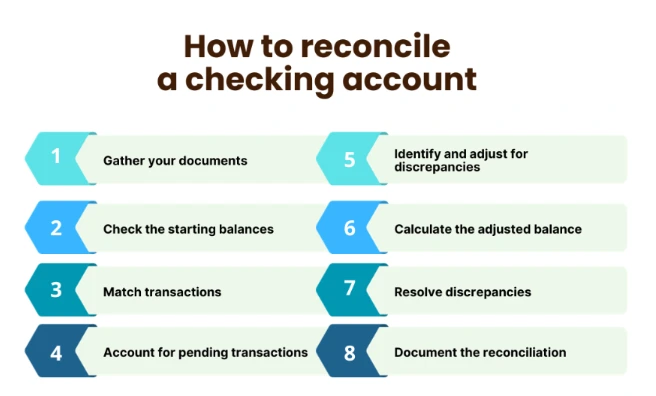
Professional bookkeepers follow a 5-step reconciliation process that moves from document collection through to verified balance confirmation. Tools like QuickBooks Online and Xero automate transaction importing and initial matching, but a trained bookkeeper interprets the results, investigates exceptions, and produces the final signed report.
| Step | Action | What the Bookkeeper Does |
| 1 | Gather documents | Collects bank statements and pulls internal records from the accounting system |
| 2 | Compare transactions | Matches each bank transaction against the general ledger line by line |
| 3 | Identify discrepancies | Flags bank fees, deposits in transit, outstanding cheques, and missing entries |
| 4 | Adjust records | Post adjusting journal entries to correct the general ledger |
| 5 | Verify final balance | Confirms the adjusted book balance matches the bank statement closing balance |
Ontario businesses working with professional bookkeeping services receive a completed reconciliation report each month, delivered by the 10th, with all discrepancies documented and resolved.
What Happens When Bank Accounts Aren’t Reconciled?
Unreconciled bank accounts produce inaccurate financial statements, increase CRA audit risk, and leave fraudulent transactions undetected. The consequences extend beyond messy books.
The CRA imposes penalties on businesses that cannot produce accurate, verifiable financial records during a review. The risk escalates further for payroll: under Section 227.1 of the Income Tax Act, company directors are personally liable for unremitted payroll deductions when a corporation fails to meet its obligations.
Without reconciliation, 4 specific problems emerge:
- Cash flow errors: the bank balance and book balance diverge, producing false cash position data
- Tax filing inaccuracies: unverified figures in HST returns and corporate tax filings trigger CRA reassessments
- Undetected fraud: duplicate payments, unauthorized transactions, and ghost vendors go unnoticed
- Audit exposure: inconsistent records flag the business for CRA review; unreconciled accounts are treated as a risk signal
Accurate tax preparation and filing depend entirely on reconciled books: unverified figures create filing errors that trigger reassessments. Businesses already under review benefit from CRA audit support to navigate the process with verified, reconciled records as their defence.
Bookkeeper vs. Accountant: Who Handles Reconciliation?
Bookkeepers perform reconciliation monthly as an ongoing operational function; accountants review reconciliation reports at quarter-end or year-end to prepare financial statements and tax filings. The roles are complementary, not interchangeable.
CPB Canada defines the bookkeeper’s scope as maintaining day-to-day financial records, reconciling accounts, and preparing reports for the accountant or owner review. The CPA designation governs the accountant’s scope: financial statement preparation, complex adjustments, and regulated tax advisory work.
| Role | Reconciliation Responsibility | Frequency |
| Bookkeeper | Matches transactions, identifies discrepancies, maintains the general ledger, and delivers a signed reconciliation report | Monthly |
| Accountant / CPA | Reviews reconciliation reports, handles complex adjustments, prepares tax filings, and financial statements | Quarterly or year-end |
| Business Owner | Reviews signed-off reconciliation report, approves discrepancy resolutions, and makes decisions based on verified data | Monthly |
A business that skips the bookkeeper layer and relies on an accountant alone for reconciliation pays CPA rates of $150 to $400 per hour for work that a certified bookkeeper performs at a fraction of that cost.
Monthly reconciliation also directly supports accurate GST/HST filings, whether you file monthly, quarterly, or annually, and ensures your payroll figures are accurate for annual WSIB reporting. Both obligations require clean, reconciled records.
Red Flags Your Bookkeeper Isn’t Reconciling Properly
4 warning signs indicate a bookkeeper is not performing reconciliation correctly.
- Reports delivered with no discrepancy notes. Every reconciliation produces either a clean match or a list of investigated discrepancies. A report with no notes is either incomplete or fabricated. The CRA requires a documented audit trail; a clean report with no supporting detail does not satisfy that requirement.
- Book balance never matches the bank statement. A persistent gap between the general ledger balance and the bank statement closing balance means that adjusting journal entries are not being posted. The absence of adjusting journal entries confirms reconciliation is not being performed.
- Reconciliation completed less than monthly. CPB Canada’s professional standards identify monthly reconciliation as the minimum frequency for small business accounts. Quarterly or ad hoc reconciliation allows errors and fraud to compound across multiple periods.
- No documented adjusting entries in the accounting system. QuickBooks and Xero both maintain a dated log of all journal entries. A bookkeeper performing reconciliation correctly leaves a clear, timestamped record of every adjustment. The absence of this log confirms reconciliation is not occurring.
Frequently Asked Questions
How often should bookkeepers reconcile bank accounts?
Monthly reconciliation is the professional standard for small business accounts. Based on our 17 years of client work, businesses processing over 200 transactions per month require weekly reconciliation to prevent error backlog and catch discrepancies within days rather than weeks. The Acctax Company delivers reconciliation reports by the 10th of each month for all clients.
What is the difference between bank reconciliation and bookkeeping?
Bookkeeping is the ongoing recording of all financial transactions; bank reconciliation is the monthly verification process that confirms those records match the bank statement. Reconciliation is one component of a complete bookkeeping system; it cannot function correctly without accurate day-to-day transaction recording as its foundation.
Can accounting software replace a bookkeeper for reconciliation?
Accounting software like QuickBooks and Xero automates transaction matching, but cannot replace a bookkeeper for reconciliation. Software identifies potential matches and flags unmatched items; a trained bookkeeper investigates flagged exceptions, determines the correct treatment for timing differences such as outstanding cheques and deposits in transit, posts adjusting journal entries, and produces a signed reconciliation report.
What financial records does the CRA require Canadian businesses to keep?
The CRA requires Canadian businesses to retain all financial records, including bank statements, general ledgers, and reconciliation reports, for a minimum of 6 years from the end of the last tax year those records relate to. Businesses subject to a CRA audit that cannot produce reconciled records for this period face penalties and reassessments.
Reconciled Books Are Non-Negotiable
Reconciled bank accounts are not a bookkeeping bonus; they are the foundation of CRA-compliant, audit-ready financial records. Every unreconciled month is a month where errors compound, fraud goes undetected, and your tax filings rest on unverified numbers.
The Acctax Company performs monthly bank reconciliation for Ontario small businesses across Kitchener, Waterloo, and Cambridge. Contact us to confirm your books are reconciled, accurate, and CRA-ready, or to arrange a review of your current records through our professional bookkeeping services.